
A conversation about a crown for a primary tooth often starts with color. A parent says “just not a silver one,” and the dentist has not yet judged how much tooth remains, or whether the chosen crown can be placed. The reverse happens too: the family is ready for a metal crown because they fear a long appointment for zirconia. In both cases it is more useful to discuss the tooth and the course of the visit first, and the material after that.
For a pediatric dentist this is not a choice between two pictures in a catalog. They need to know whether the tooth needs full coverage, which restorations are acceptable in this situation, and what the child can manage at the appointment. Parents need to hear not only the name of the crown, but the reason for the recommendation. That conversation usually removes more objections than a promise that one material suits everyone.
A crown is not offered merely because the tooth is primary, or because it already has a filling. The dentist assesses the tooth, how much tissue remains, and what restoration is possible. If they recommend full coverage, it helps to show parents what the decision is based on. The conversation then has something to hold on to. A photograph, or a description of the symptoms, cannot decide the right restoration. The final plan is made after the child has been seen.
It is especially easy to mix the choice of material with the question of whether a crown is needed after pulp treatment. A parent hears that the tooth was treated and concludes that a crown is now compulsory. In practice the dentist has to explain the decision for this tooth, not by pointing at a single diagnosis or at previous treatment. If several restorations are possible, the family should understand why one of them is being suggested. If the state of the tooth limits the choice, that is better said plainly.
I would not start that conversation with samples of crowns. First I show what has to be restored, and I ask what the family is hoping for. For some parents the color of a front tooth is what they notice. Others are more worried about how the child will cope with the treatment. Those wishes matter. They do not replace the clinical assessment. Once the order is clear, talking about a metal or a zirconia crown is much easier.
A metal crown keeps the color of the metal. A zirconia crown looks light. For the family that is an obvious difference, especially on a tooth that shows when the child talks or smiles. The position of the tooth is not a ready answer: a molar can be visible too, and parents differ in what they want the tooth to look like. So I ask them to show me what actually worries them before we discuss the material. Do not promise that a light crown will match the neighboring teeth exactly.
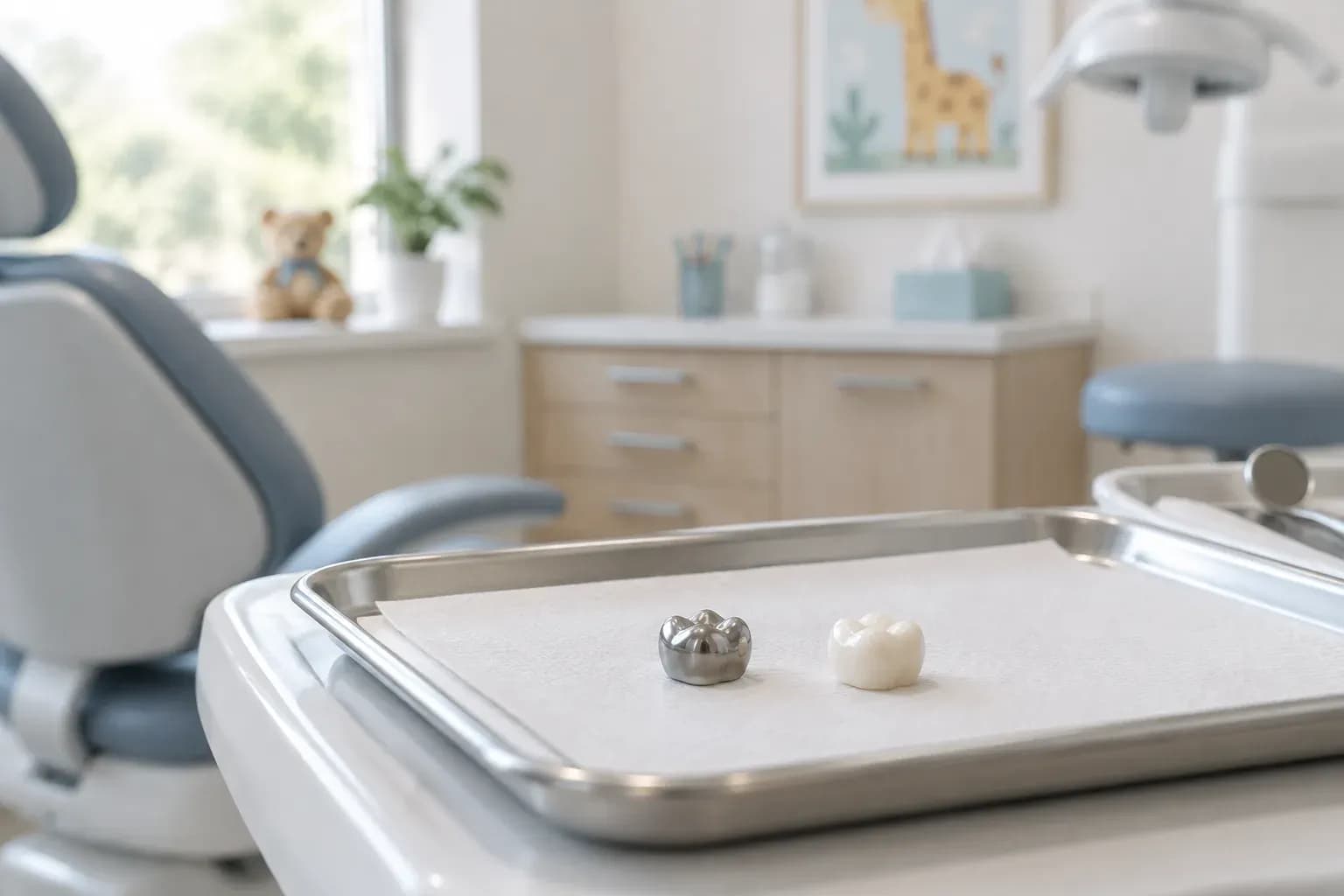
The dentist assesses not only the appearance, but whether a preformed crown can be seated on this tooth. An anterior primary tooth, a canine, and a molar are different: the shape of the tooth, access to it, and the preparation required all matter. “White at the front, metal at the back” does not take those details into account. If a parent asks for a zirconia crown on a molar, explain whether it is suitable in this case, and why. If the dentist recommends metal, “that is what we usually do” is not enough on its own.
No material should be presented as a universal choice, or promised to last until the tooth is shed. The result depends on the tooth at the start, on how accurately the crown is seated, on care, and on follow-up. That does not make the conversation about appearance secondary: the child and the parents will see the crown every day. The dentist's job is to separate an aesthetic wish from the conditions without which the crown cannot be placed. The decision then looks neither imposed nor taken from a photograph.
A preformed zirconia crown needs a prepared tooth of a suitable shape. Do not expect to crimp it at try-in the way a metal crown can be crimped. Seating the crown means its position on the tooth after preparation and try-in. The dentist judges whether there is enough room, and how much tooth has to be removed. There is no universal depth of preparation for every child. It depends on the clinical situation and on the crown that was chosen. A light sample in the catalog does not mean it will suit this patient.
I prefer to take “the child will not sit through it” before the material is chosen, not after. Age, previous treatment, how ready the child is to cooperate, and access to the tooth all matter. It helps to ask parents what happened at previous visits: what helped, and at which point it became difficult. The dentist then explains the expected steps, and the limits. Before the examination, and before meeting the child, do not promise a particular crown or an exact number of visits.
After placement, the work is not finished when the size and the color have been chosen. The dentist checks the position of the crown, its margins, and the bite. The family is shown how to look after the crown at home, and when to come back for review. Parents do not need to judge the seating themselves, or try to adjust anything. If there are complaints after treatment, or the crown has shifted, contact the treating dentist. That agreement is more useful than a general promise that the crown will never raise another question.
A buyer needs a range, but the list of materials is better drawn up with the dentists who will use it. Discuss which groups of teeth they restore, which crowns they plan to use, and which questions come up again and again. The order is then tied to the real work of the clinic, not only to a preference for color. Stock does not decide treatment: for each child the dentist chooses the restoration after the examination. A parent should hear that as clearly as the difference between the materials.
At the consultation I try to leave the family with a clear next step. Why a crown is being suggested, which options the dentist considers acceptable, what placement will require, and when a review is needed — those questions are better closed before the treatment is booked. If the tooth hurts, or there are other complaints, a discussion of appearance should not delay the examination. The cause of the complaints, and the order of care, are for the clinician. That conversation helps a decision without pressure, and without promises that cannot be made in advance.
The company has worked in pediatric dentistry and orthodontics since 2016. The warehouse and the production are in Novosibirsk. Pediatric metal and zirconia crowns are in stock, and orders ship the day after payment. The company's medical devices have registration certificates and quality documents. If you are equipping a clinic, or planning to work with these crowns, the range and purchasing can be discussed at zaykovlab@yandex.ru. Whether a particular restoration is suitable for a patient is decided by the treating dentist.
There are contraindications. A consultation with a specialist is required.
 Expert materials
Treating the tooth and general anesthesia are separate decisions. What to prepare, and what to ask the dentist and the anesthesiologist before the procedure.
 Expert materials
Age, and the look of one crooked tooth, do not decide which brace system to use. What an orthodontist needs before a treatment plan and an order for appliances.